
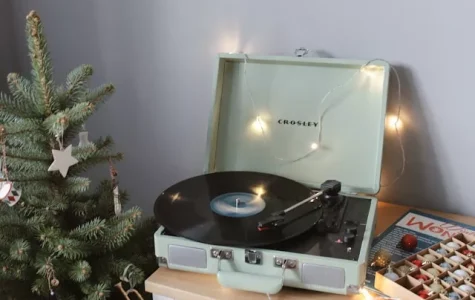
Not a party record. A window, a night sky, and one voice keeping itself company.
Most Christmas albums are built for a crowded room. Frank Sinatra’s, released by Capitol in September 1957, was built for the opposite — a listener by himself, maybe by a window, letting the season settle in without needing anyone else there to validate it.
A Jolly Christmas from Frank Sinatra arrived at the exact moment Sinatra’s Capitol years were reaching their peak. It sat on the release calendar between A Swingin’ Affair! and Come Fly with Me, two albums now considered high-water marks of the American songbook, arranged by Nelson Riddle and Billy May respectively. For his Christmas record, Sinatra turned instead to Gordon Jenkins, whose lush, unhurried orchestration gave the album a completely different temperature than the snap and swagger surrounding it — brassy on “Jingle Bells,” yes, but mostly patient, mostly interior, closer to loneliness than to a party.
It wasn’t Sinatra’s first attempt at holiday music. He’d cut Christmas songs for Columbia back in the 1940s with arranger Axel Stordahl, including a tender, boyish “White Christmas” in 1944 that he’d rerecord a decade later with a voice that had aged into something rougher and more knowing. But the Capitol record is where Sinatra’s Christmas persona fully arrived — less crooning teen idol, more a man taking real stock of the season, alone with it on his own terms.
One detail says more about Sinatra’s relationship to this material than almost anything else: before recording “Have Yourself a Merry Little Christmas” for the album, he placed a call to lyricist Hugh Martin. The song, written for Judy Garland in Meet Me in St. Louis, had always carried a melancholy streak in its original lyric — lines about how there might not be a next year, how the family might soon be scattered. Sinatra found that too heavy for what he wanted the song to do, and asked Martin, decades before anyone talked about artists having that kind of leverage, whether the words might be softened. Martin obliged. The version most people know today, the hopeful one, exists because Sinatra picked up a phone and asked.
That instinct — to take a song exactly as far into feeling as it needed to go, and no further — is the throughline of the whole record. Sinatra’s Christmas albums never ask you to perform joy you don’t have. They just sit with you in whatever kind of December you’re actually having, which may be why, seven decades on, he’s still the artist people reach for on the quietest nights of the season, not just the loudest ones.